
Carpet pattern forming and straight cutting can be connected in one production line. This demonstration combines belt conveying, heated forming, longitudinal slitting and cross cutting to produce carpet tiles.
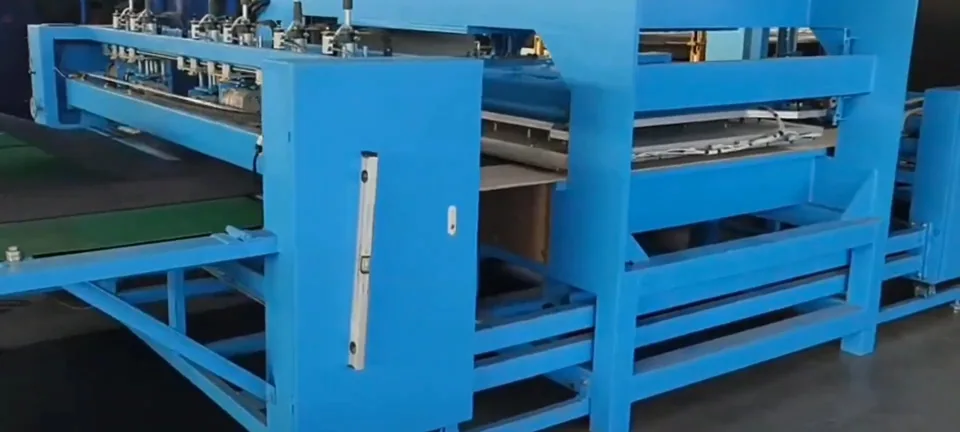
The process shown in the video
Black carpet material travels through an upper and lower belt conveying arrangement. Heated molds form a textured pattern on the carpet surface. Downstream cutting stages divide the material into the required width and length.
Longitudinal slitting sets the width of the strips along the direction of travel. Cross cutting divides those strips across the travel direction to set the finished length. These two operations produce straight-sided pieces.
When this arrangement is useful
This process suits a carpet product that needs a formed surface pattern and a rectangular finished size. Connecting the forming and cutting stages allows the material to pass through the required operations in sequence.
A shaped automotive floor mat has a different cutting requirement. Its outline needs a suitable cutting process and tooling; the straight slitting and cross-cutting arrangement shown here should be assessed against the actual part drawing.
What changes with a different carpet product
The material construction and required surface pattern guide the forming configuration. Incoming width and finished dimensions guide the slitting and cross-cutting arrangement. The upstream supply and finished-part collection also need to fit the proposed line.
For a similar customized production line, provide a material sample, a reference for the pattern, the incoming width and the finished tile dimensions. Production rate and end-of-line handling need to be reviewed with the actual carpet construction and the collection method.
Send your carpet process requirements to discuss the forming and cutting stages together.
Watch the process
Watch this process on YouTube.
Yancheng Golden Eagle Machinery Manufacturing Co., Ltd.